
Beyond the Balance Sheet: Decoding Football's Global Brand Strength Index
By Regina Miranda
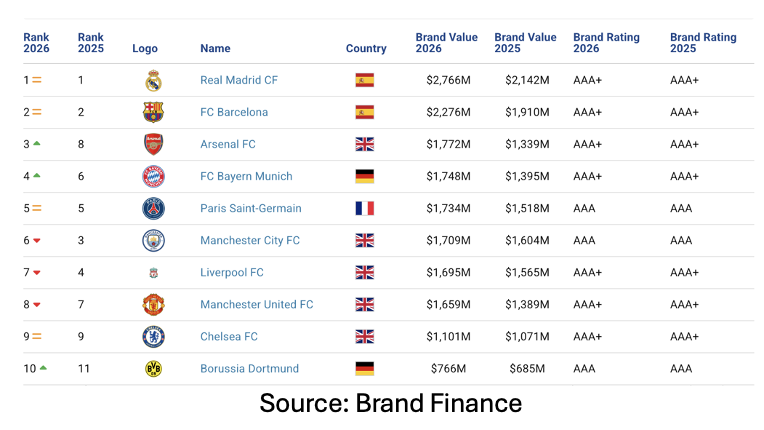
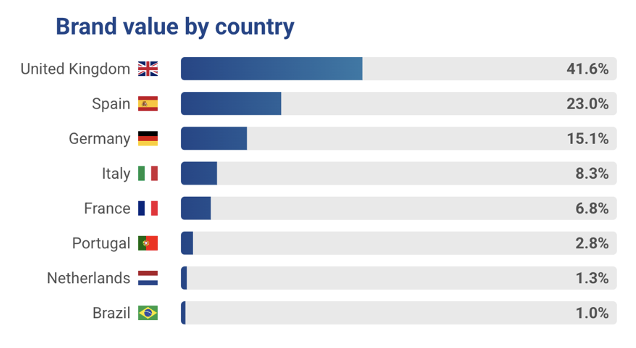
Football is far more than a 90-minute spectacle played on grass, it is a multi-billion-dollar psychological ecosystem where loyalty, heritage, and emotional connection dictate commercial destiny. While traditional financial analysis often obsesses over matchday gate receipts and television broadcast rights, true market dominance requires looking deeper into consumer perception. According to recent industry metrics from Brand Finance's Football Report, football's global brand value is heavily concentrated in Europe, but brand strength tells a profoundly different, decentralized story that marketers cannot afford to ignore.
When evaluating the Brand Strength Index (BSI) scores across the globe, it becomes abundantly clear that powerful club brands are not built on revenue alone. Reputation, historical heritage, unwavering supporter passion, and intense relevance in local and emerging markets carry immense weight. This structural reality explains why Brand Finance evaluates the strongest clubs far beyond Europe's traditional borders, capturing powerhouse institutions in markets like Brazil, the United States, Japan, China, the United Arab Emirates, and Saudi Arabia.
A look at the data reveals fascinating geographic champions leading their respective territories. In Europe's traditional powerhouses, Real Madrid C.F. commands an astonishing BSI score of 95.8 out of 100 in Spain, while Arsenal Football Club leads the UK with 94.0, closely matched by FC Bayern München in Germany also at 94.0. Meanwhile, Paris Saint-Germain anchors France at 86.7, FC Porto leads Portugal at 81.9, and Juventus Football Club anchors Italy at 78.5. These figures illustrate that European dominance is underpinned by decades of equity accumulation and relentless global fan engagement.
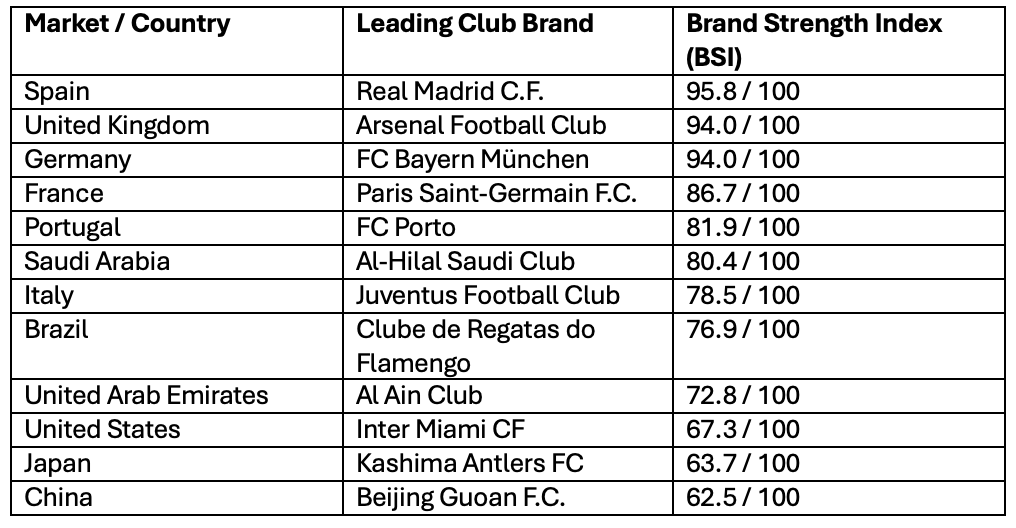
However, the most compelling marketing narrative unfolds outside Europe, where domestic fan engagement is extraordinarily resilient and primed for commercial explosion. In Saudi Arabia, Al-Hilal Saudi Club stands tall with a stellar BSI score of 80.4, proving that strategic investments in star talent and league visibility translate into elite brand equity. Similarly, Clube de Regatas do Flamengo leads Brazil with a robust BSI of 76.9, demonstrating how deeply ingrained football culture creates unbreakable consumer loyalty across South America.
Further east and across the Americas, regional titans are redefining local sports marketing landscapes. Al Ain Club anchors the United Arab Emirates with a competitive BSI of 72.8, while in North America, Inter Miami CF captures the spotlight in the United States with a BSI of 67.3, supercharged by superstar convergence. In Asia, Kashima Antlers FC leads Japan with 63.7, and Beijing Guoan F.C. anchors China with 62.5, showcasing massive untapped potential for international brand partnerships and localized digital activation.
"In modern sports marketing, revenue opens the door, but brand strength dictates longevity. The future belongs to agencies and clubs that translate regional passion into global digital ecosystems." Dario Brignole, CEO of Shine Entertainment Media
Looking to the future, sports marketers must pivot from traditional broadcasting models toward immersive, community-driven digital strategies. As fan expectations evolve, clubs that harness data analytics and localized content creation will successfully bridge the gap between regional passion and global commercial monetization. Agencies specializing in sports entertainment must design agile sponsorship frameworks that respect cultural nuance while maximizing digital touchpoints across international borders.
Ultimately, the Brand Finance findings serve as both a benchmark and a roadmap for industry leaders. Brands like Flamengo, Al-Hilal, and Inter Miami prove that equity is no longer the exclusive domain of European giants. By cultivating authentic supporter communities and leveraging innovative sports marketing campaigns, emerging market clubs are well-positioned to disrupt the global hierarchy over the next decade.
In conclusion, navigating the future of football marketing requires embracing this dual reality: while European powerhouses hold the highest absolute valuations, the true growth frontier lies in understanding and amplifying global brand strength. For marketers, creators, and club executives alike, the mandate is clear, invest in emotional equity, honor local heritage, and build campaigns that resonate deeply wherever fans live and breathe the game.
Sources
Brand Finance (2026) The annual report on the most valuable and strongest football club Brands. https://brandirectory.com/reports/football
Izham, M. D. A. (2026, 20 agosto). Football's elite pull further ahead as global brand value nears €24 billion and European hierarchy. Brand Finance. https://brandfinance.com/press-releases/footballs-elite-pull-further-ahead-as-global-brand-value-nears-e24-billion-and-european-hierarchy-shifts
Real Madrid is, for the third consecutive year, the most valuable football brand in the world and, for the fifth year, the strongest brand, according to Brand Finance. (2026, 25 agosto). Real Madrid Is, For The Third Consecutive Year, The Most Valuable Football Brand In The World And, For The Fifth Year, The Strongest Brand, According To Brand Finance. https://www.realmadrid.com/en-US/news/club/latest-news/el-real-madrid-es-por-tercer-ano-consecutivo-la-marca-de-futbol-mas-valiosa-del-mundo-y-por-quinto-ano-la-marca-mas-fuerte-segun-brand-finance-20-08-2026